
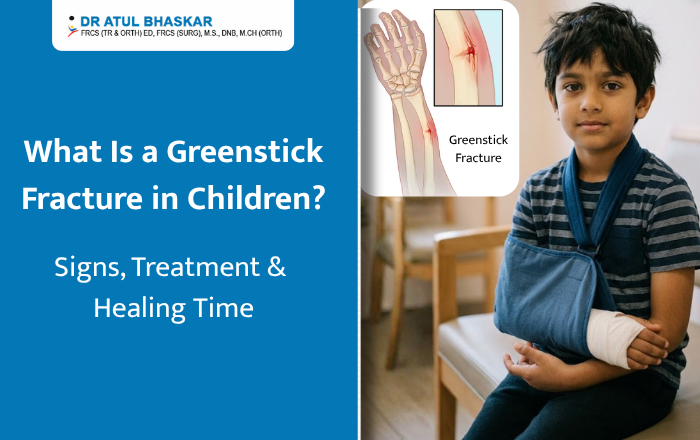
Your child was playing outside, tripped, and landed awkwardly — now they’re crying and holding their arm. You rush over, expecting the worst, but there’s no obvious break. Could it still be a fracture? Yes, it absolutely could. It might be a greenstick fracture — one of the most common yet misunderstood bone injuries in children.
As a parent, understanding what a greenstick fracture in children is, how to spot it early, and what treatment looks like can save your child from unnecessary pain and complications. Let’s break it all down in simple, clear terms.
A greenstick fracture is an incomplete bone break where the bone bends and cracks on one side but doesn’t break all the way through. Picture trying to snap a fresh green twig — it bends and splits rather than breaking cleanly. That’s exactly what happens inside your child’s bone.
This type of fracture happens almost exclusively in children because kids’ bones are softer and more flexible than adult bones. The younger the child, the more pliable their bones — which is why greenstick fractures are most common in children under 10 years of age.
The most common locations include:
Because the bone doesn’t fully snap, a greenstick fracture can easily be mistaken for a sprain. Here’s what to look for:
Take your child to a doctor right away if:
Never assume it’s just a sprain. In growing children, untreated fractures can affect long-term bone development.
A doctor will first do a physical examination — checking for swelling, tenderness, and movement. An X-ray is then used to confirm the greenstick fracture diagnosis. In some cases, two different angled X-ray views are needed because the fracture line can be very subtle.
Rarely, an MRI may be ordered if the fracture is near a growth plate.
The good news is that most greenstick fractures heal without surgery. Treatment depends on how much the bone has bent.
1. Casting A plaster or fibreglass cast is the most common treatment. It holds the bone still while it heals and prevents the bend from getting worse. Most children wear a cast for 4 to 8 weeks.
2. Splinting For mild cases, a splint may be used initially — especially while swelling is still present — before a proper cast is applied.
3. Realignment (Closed Reduction) If the bone is bent more than 15–20 degrees, the doctor will gently straighten it before casting. This is done under sedation so your child feels no pain during the process.
4. Surgery Surgery is rarely needed for greenstick fractures. It is only considered in very severe cases where the bone cannot be properly aligned otherwise.
Children’s bones heal much faster than adults’ because they are still actively growing. Here’s a simple guide:
| Child’s Age | Healing Time |
|---|---|
| Under 2 years | 3–4 weeks |
| 2–5 years | 4–6 weeks |
| 6–10 years | 6–8 weeks |
| 10+ years | 8–12 weeks |
After the cast comes off, mild stiffness and weakness are completely normal. Most children return to sports and full activity within 2–4 weeks after cast removal.
Q1. Can a child walk with a greenstick fracture?
If the fracture is in the leg, some walking may be possible — but it can make the injury worse. Always get an X-ray before letting your child put weight on an injured leg.
Q2. Does a greenstick fracture need a cast?
Almost always, yes. Without a cast, the bone can bow further or heal in a bent position, causing long-term issues.
Q3. Will it affect my child’s bone growth?
When diagnosed and treated on time, it typically does not affect growth. However, if the growth plate is involved, your doctor will monitor the healing closely.
A greenstick fracture may sound less serious than a full break — but it is still a real fracture that needs proper treatment. Catching it early and treating it correctly makes all the difference.
When it comes to your child’s bones, you want a doctor who has seen it all — and treated it all.
Dr. Atul Bhaskar is one of Mumbai’s most trusted Paediatric Orthopaedic Surgeons with 33+ years of experience treating children’s bone injuries, including greenstick fractures. Families across Mumbai rely on Dr. Bhaskar for his calm, child-friendly approach and his deep knowledge of growing bones.
✅ 33+ years in paediatric orthopaedics
✅ Thousands of successful fracture treatments in children
✅ Gentle, child-friendly approach
✅ Trusted by Mumbai families for over three decades
Your child’s bones are still growing — make sure they heal right.
Book a consultation with Dr. Atul Bhaskar today and give your child the care their recovery truly deserves.
Dr. Atul Bhaskar, one of the prominent Paediatric Orthopaedic Surgeon in India has graduated from Seth G S Medical College, Mumbai. After doing his M.S (Orth) from K.E.M. Hospital, he pursued further training in the United Kingdom. He was on the “Yorkshire Orthopaedic Training Program” and obtained his orthopaedic fellowship, FRCS (Orth) and Surgical fellowship, FRCS (Glasgow) degrees. He has received the M.Ch Orth form Liverpool.
© Copyright 2026 Dr. Atul Bhaskar | All rights reserved.
Designed By DMX Digital