
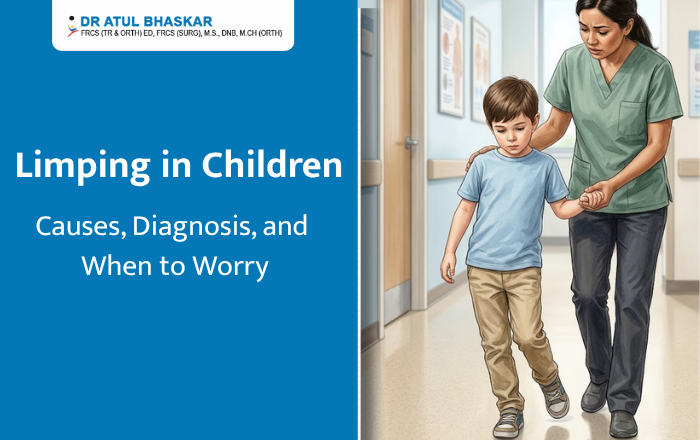
If you’ve noticed your child limping lately, you’re probably worried. And that’s completely normal. As a parent, watching your child walk differently — dragging one leg, favouring one side, or wincing with each step — is unsettling. But here’s the reassuring truth: limping in children is more common than most parents realise, and many causes are simple and treatable. That said, some causes do need urgent attention. This blog will walk you through everything you need to know — from common reasons to serious warning signs — so you can make the right call at the right time.
A limp in a child simply means their walking pattern has changed. It can happen because of pain, weakness, or a structural problem in the leg, hip, knee, or foot. Doctors broadly classify limps into three types — pain-related (antalgic), weakness-related (Trendelenburg), or mechanical (like a leg length difference).
Age plays a big role too. A limping toddler is often looked at differently than a limping teenager, because different conditions tend to show up at different stages of development.
1. Transient Synovitis — The Most Frequent Culprit
This is the single most common reason for limping in children aged 3–10. It’s a temporary inflammation of the hip joint, often following a cold or viral infection. The good news? It usually gets better on its own within 1–4 weeks with rest.
2. Injury or Trauma
Sprains, minor fractures, or muscle pulls are obvious causes. One commonly missed injury is “toddler’s fracture” — a small crack in the shin bone that can happen even without a noticeable fall.
3. Legg-Calve-Perthes (LCP) Disease
In this condition, the blood supply to the ball of the hip joint is temporarily disrupted, causing the bone to weaken. It affects about 1 in 1,200 children, mostly boys between 4–10 years. A child limping without pain is often the first — and only — sign.
4. Septic Arthritis — A Medical Emergency
This is a bacterial infection inside a joint. If your child is limping with a fever, refuses to move their leg, and is in severe pain — go to the emergency room immediately. Septic arthritis can permanently damage a joint within hours if not treated.
5. Slipped Capital Femoral Epiphysis (SCFE)
This condition affects teenagers, particularly overweight boys. The “ball” of the hip slips off its normal position. Many children with SCFE complain of knee pain — but the real problem is in the hip. Surgery is almost always needed.
6. Growing Pains vs. Juvenile Arthritis
True growing pains cause nighttime aching in both legs and do not cause a limp. If your child is limping, has joint swelling, or feels stiff in the mornings for more than 6 weeks, juvenile arthritis should be evaluated.
7. Flat Feet or Hip Dysplasia
These structural conditions often cause a painless limp in young children and are frequently missed. Early detection makes treatment far simpler.
8. Osteomyelitis (Bone Infection)
Similar to septic arthritis, this is a bone infection that causes fever, localised bone pain, and reluctance to walk. It needs prompt treatment with antibiotics or surgery.
9. Rare but Serious: Bone Tumors and Leukemia
A persistent child limping — especially with night pain, fatigue, or unexplained weight loss — should never be ignored. Bone pain is a presenting symptom in roughly 25% of childhood leukemia cases. This is rare, but worth ruling out.
Do not wait. Contact your doctor immediately if your limping child shows any of these signs:
When you bring your limping child to a doctor, here’s what typically happens:
Physical examination comes first. The doctor watches your child walk, checks the range of motion in the hip and knee, looks for swelling, and compares leg lengths.
Investigations are chosen based on what’s suspected. X-rays pick up fractures, LCP disease, and SCFE. An ultrasound can detect fluid in the hip joint — a key difference between harmless transient synovitis and dangerous septic arthritis. Blood tests (CRP, ESR, white blood cell count) check for infection or inflammation. An MRI is used when soft tissue or early avascular necrosis needs to be assessed.
Doctors also use the Kocher Criteria — four clinical markers — to quickly identify children at high risk for septic arthritis. The more criteria a child meets, the greater the urgency.
Surgery becomes necessary for SCFE, severe LCP disease, septic arthritis (joint drainage), and untreated hip dysplasia. The earlier surgery is done when needed, the better the outcome for the growing joint.
Limping in children is not always serious — but it should never simply be dismissed. Growing bones and joints respond well to early treatment. The longer a problem goes undetected, the harder it becomes to correct. Trust your instincts. You know your child. If the limp isn’t going away, or something feels off, get it checked.
If your child is limping and you’re not sure why, Dr. Atul Bhaskar is a trusted Pediatric Orthopedic Surgeon practising in Mumbai and Thane who specialises in bone and joint conditions in children. From limping toddlers to teenagers with hip pain, Dr. Bhaskar evaluates and treats the full range of pediatric limping causes with clarity and care.
Early evaluation can prevent small problems from becoming serious ones. Book a consultation today and get the answers your child deserves.
📍 Serving families across Mumbai and Thane
Dr. Atul Bhaskar, one of the prominent Paediatric Orthopaedic Surgeon in India has graduated from Seth G S Medical College, Mumbai. After doing his M.S (Orth) from K.E.M. Hospital, he pursued further training in the United Kingdom. He was on the “Yorkshire Orthopaedic Training Program” and obtained his orthopaedic fellowship, FRCS (Orth) and Surgical fellowship, FRCS (Glasgow) degrees. He has received the M.Ch Orth form Liverpool.
© Copyright 2026 Dr. Atul Bhaskar | All rights reserved.
Designed By DMX Digital