
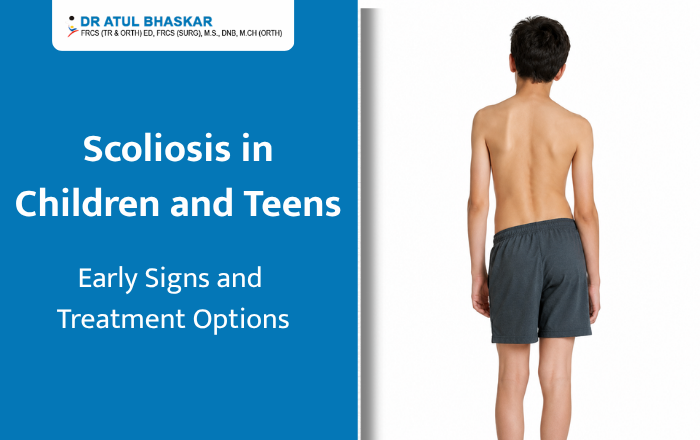
Scoliosis in children and teens is a condition in which the spine develops an abnormal sideways curve. It often becomes noticeable during the rapid growth that occurs around puberty. Some curves are mild and only need regular monitoring, while others may progress as a child grows and require treatment.
Recognising the early signs can help parents seek an assessment at the right time. Treatment depends on factors such as the degree of spinal curvature, the child’s age, remaining growth, symptoms and whether the curve is changing over time.
Scoliosis is more than simply having poor posture. The spine may curve to one side and can also rotate, making the back appear uneven. The curve may resemble a “C” or “S” shape.
The most common type in adolescents is adolescent idiopathic scoliosis, where an exact cause cannot be identified. It most commonly develops from around age 10 through the teenage years. Other forms can be associated with conditions affecting the muscles and nerves or abnormalities present in the spine from birth.
Many children with mild scoliosis have no pain or obvious symptoms. This is why parents may notice changes in posture or body symmetry before the child complains of a problem.
Parents can look for changes in the child’s back, shoulders and waist, particularly during growth spurts.
Common signs include:
These signs do not necessarily mean that a child has scoliosis. Postural differences and other conditions can produce similar appearances. A healthcare professional can determine whether a spinal curve is actually present.
Back pain is not always present in adolescent scoliosis. However, significant pain, particularly when accompanied by other symptoms, should be medically evaluated rather than automatically attributed to scoliosis.
A doctor generally begins with a physical examination, looking at the child’s posture, shoulder and hip alignment and the appearance of the spine when standing and bending forward.
If scoliosis is suspected, imaging may be recommended to evaluate the spine and measure the degree of curvature. The angle of the curve, together with the child’s skeletal maturity and growth potential, helps guide treatment decisions.
Regular follow-up can be particularly important while a child is still growing because some curves can progress during periods of rapid growth.
There is no single treatment that is appropriate for every child. Management is generally based on the severity and progression of the curve and how much growth remains.
Mild curves may not require active treatment. Instead, the doctor may recommend regular examinations and, when appropriate, repeat X-rays to check whether the curve is changing.
The Scoliosis Research Society generally describes observation as an option for curves below approximately 25 to 30 degrees, although the decision depends on the individual child.
Observation does not mean ignoring scoliosis. It means monitoring the child’s spine carefully so treatment can be considered if the curve progresses.
A scoliosis brace may be recommended for a growing child with a moderate curve that has a meaningful risk of progression.
Bracing is intended primarily to slow or prevent further worsening while the child continues to grow. The type of brace and recommended wearing schedule depend on the child’s curve and individual circumstances.
For children who need bracing, following the prescribed wearing schedule can influence how effective the treatment is.
Surgery is considered for selected children with severe or significantly progressive curves, particularly when non-surgical treatment is not sufficient or the curve is unlikely to respond to bracing.
For adolescent idiopathic scoliosis, spinal fusion with instrumentation is commonly used when surgery is indicated. The procedure aims to prevent further progression and correct the curve to an appropriate degree.
Surgery is not required for most children with mild scoliosis. The decision should be made after considering the child’s growth, curve pattern, progression and overall health.
Yes. A spinal curve can progress as a child grows, particularly during periods of rapid growth. This is one reason early assessment and follow-up are important.
A child who has been diagnosed with scoliosis may therefore need periodic assessment until growth is substantially complete. The frequency of follow-up depends on the severity of the curve and the child’s stage of growth.
Parents should consider arranging an evaluation if they notice:
Early evaluation does not automatically mean that a child will need a brace or surgery. In many cases, the first step is simply confirming whether scoliosis is present and monitoring its development.
1. Can scoliosis in children be corrected?
Treatment can control progression and, depending on the severity and treatment used, improve the spinal curve. Mild curves may simply be monitored, while bracing or surgery may be considered for more significant or progressive curves.
2. Does scoliosis in teenagers always require a brace?
No. Bracing is generally considered for selected growing children with curves at a level where progression is a concern. Mild curves may only require observation.
3. Is scoliosis caused by poor posture?
Usually, no. Adolescent idiopathic scoliosis is not simply the result of sitting incorrectly or having poor posture. In the most common form, the exact cause is unknown.
4. Can children with scoliosis play sports?
Many children with scoliosis can remain physically active. However, activity recommendations may differ depending on the child’s condition and whether they are undergoing treatment. Parents should discuss any specific restrictions with the treating doctor.
Scoliosis in children and teens can sometimes be difficult to notice because early or mild curves may cause no symptoms. Uneven shoulders, hips, shoulder blades or waistlines can be useful warning signs that deserve professional assessment.
The good news is that not every child with scoliosis needs active treatment. Depending on the curve and the child’s growth, management may involve observation, bracing or, in selected cases, surgery. Early assessment allows the child’s spinal development to be monitored and treatment to be considered when appropriate.
If you notice signs of scoliosis or changes in your child’s posture or back, consulting a qualified pediatric orthopedic specialist can help determine whether further evaluation is needed.
Dr. Atul Bhaskar, Pediatric Orthopedic Surgeon, with 35+ years of experience, provides specialist evaluation for orthopedic concerns affecting children and adolescents. For parents concerned about possible scoliosis or changes in a child’s spinal alignment, a professional assessment can help determine the appropriate next steps.
Dr. Atul Bhaskar is available for consultation in Mumbai and Thane.
Name – Dr. Atul Bhaskar, Pediatric Orthopedic Surgeon
Address: B Wing, Laxmi Business Park, Room No. 114, Sab T V – Kalinga Ln, off New Link Road, Laxmi Industrial Estate, Suresh Nagar, Andheri West, Mumbai, Maharashtra 400053
Phone: 98216 22992
Dr. Atul Bhaskar, one of the prominent Paediatric Orthopaedic Surgeon in India has graduated from Seth G S Medical College, Mumbai. After doing his M.S (Orth) from K.E.M. Hospital, he pursued further training in the United Kingdom. He was on the “Yorkshire Orthopaedic Training Program” and obtained his orthopaedic fellowship, FRCS (Orth) and Surgical fellowship, FRCS (Glasgow) degrees. He has received the M.Ch Orth form Liverpool.
© Copyright 2026 Dr. Atul Bhaskar | All rights reserved.
Designed By DMX Digital