
When parents hear that their baby has hip dysplasia, one of the first concerns is often, “Will my baby need surgery?” The good news is that hip dysplasia in babies can often be treated without surgery, particularly when it is diagnosed early.
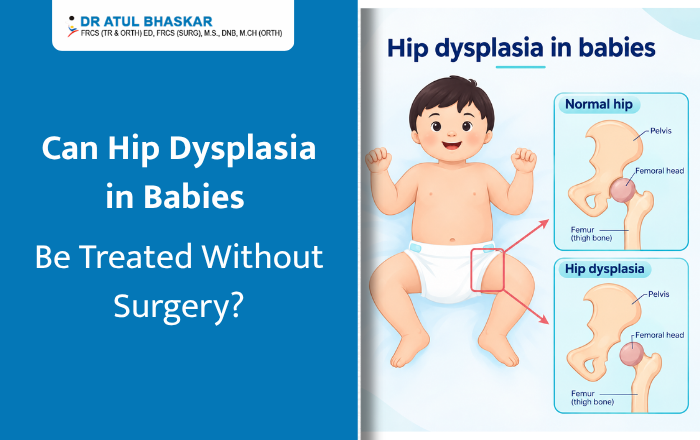
Developmental dysplasia of the hip (DDH) is a condition in which the hip joint does not develop or remain in its normal position. In some babies, the hip is loose or unstable, while in more severe cases, the ball of the thigh bone may partly or completely come out of the hip socket.
Early diagnosis is important because treatment is generally simpler during infancy. Doctors may use a soft harness or brace to help the hip develop in the correct position.
The hip is a ball-and-socket joint. The rounded top of the thigh bone, called the femoral head, should sit securely inside the hip socket.
With developmental dysplasia of the hip:
DDH may affect one or both hips. It is often detected during a newborn examination, but some cases may not become obvious until later in infancy or childhood.
Yes. Many babies with hip dysplasia can be treated without surgery, especially when the condition is identified during the first few months of life.
The most commonly used nonsurgical treatment is a Pavlik harness. This is a soft fabric harness that holds the baby’s hips in a position that encourages the ball of the hip joint to remain inside the socket while the joint develops.
Treatment depends on factors such as:
The American Academy of Orthopaedic Surgeons has clinical guidance specifically addressing detection and nonsurgical management of DDH in infants younger than 6 months.
A Pavlik harness gently positions the baby’s hips and legs so that the hip ball stays appropriately aligned with the socket. This allows the hip joint to continue developing in a more normal position.
The harness does not mean that the baby is being immobilized completely. It allows movement of the legs while helping maintain the appropriate hip position.
Depending on the baby’s condition, the harness may need to be worn for several weeks. Treatment is monitored through regular examinations and imaging, such as ultrasound, to check whether the hip is responding properly.
Parents should follow the orthopedic team’s instructions carefully regarding:
Parents should not adjust the harness themselves unless instructed by the treating medical team.
No treatment works in every baby. Many infants respond well to harness treatment, but the outcome depends on the baby’s age, the severity of the hip problem, and other individual factors.
If the hip does not remain in the correct position with a Pavlik harness, the doctor may consider another type of brace or a different treatment approach. In some babies, surgery may eventually be necessary.
This is why regular follow-up is important even after the hip appears to have improved.
Surgery is not automatically required just because a baby has hip dysplasia.
However, surgery may be considered when:
For some older babies and children, doctors may use procedures such as closed reduction with a hip spica cast or, when necessary, open surgery to place the hip back into the correct position. The appropriate approach depends on the child’s age and the condition of the hip.
Diagnosis usually involves a physical examination and imaging.
Ultrasound is commonly used in young babies because the hip joint is still developing. It can show the position of the hip ball and the shape and development of the socket.
As the baby grows, X-rays can become more useful for assessing the developing hip joint. Your pediatric orthopedic surgeon will decide which imaging method is appropriate based on your baby’s age and condition.
Some babies have a higher likelihood of developing hip dysplasia. Risk factors include:
Having a risk factor does not mean that a baby definitely has DDH. However, babies with certain risk factors may be recommended for hip screening even when the initial examination appears normal.
A hip problem that is missed or left untreated can become more difficult to manage as the child grows. Depending on the severity, untreated DDH may contribute to problems such as an abnormal walking pattern, hip pain, stiffness, or early joint problems later in life.
This is why parents should not wait for their baby to start walking before seeking an evaluation if DDH is suspected.
If your baby has a known risk factor, an abnormal hip examination, or a doctor has raised concerns about hip development, speak with a pediatric orthopedic specialist.
Do not try to treat hip dysplasia at home or use homemade supports or positioning devices. Proper diagnosis and treatment planning are important because the baby’s hip needs to be positioned correctly without causing unnecessary pressure on the developing joint.
Hip dysplasia in babies can often be treated without surgery when it is diagnosed early. A Pavlik harness or another appropriate brace may help guide the hip into a better position and support normal development. However, not every baby responds to nonsurgical treatment, and some children may eventually need a procedure or surgery.
The earlier the condition is identified and monitored, the more treatment options may be available. If you are concerned about your baby’s hip development, an evaluation by a pediatric orthopedic surgeon can help determine the appropriate next step.
For parents looking for evaluation and treatment of hip dysplasia in babies in Mumbai, Dr. Atul Bhaskar, a Pediatric Orthopedic Surgeon with 35+ years of experience, provides consultation for pediatric orthopedic conditions, including developmental hip problems.
Dr. Atul Bhaskar’s clinic is located in Andheri West, Mumbai, and parents can consult him for assessment of suspected hip dysplasia and guidance regarding appropriate nonsurgical or surgical treatment when required.
Dr. Atul Bhaskar
Pediatric Orthopedic Surgeon
Location: Andheri West, Mumbai
Address:
B Wing, Laxmi Business Park, Room No. 114,
Sab T V – Kalinga Lane, Off New Link Road,
Laxmi Industrial Estate, Suresh Nagar,
Andheri West, Mumbai, Maharashtra 400053
Phone: 98216 22992
Dr. Atul Bhaskar, one of the prominent Paediatric Orthopaedic Surgeon in India has graduated from Seth G S Medical College, Mumbai. After doing his M.S (Orth) from K.E.M. Hospital, he pursued further training in the United Kingdom. He was on the “Yorkshire Orthopaedic Training Program” and obtained his orthopaedic fellowship, FRCS (Orth) and Surgical fellowship, FRCS (Glasgow) degrees. He has received the M.Ch Orth form Liverpool.
© Copyright 2026 Dr. Atul Bhaskar | All rights reserved.
Designed By DMX Digital