
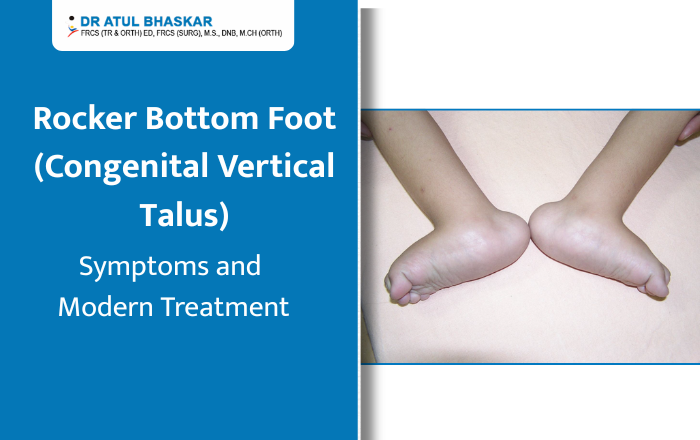
Imagine holding your newborn for the very first time and noticing that one or both of their tiny feet looks unusual — the sole curves outward like the bottom of a rocking chair, and no matter how gently you try to move it, it stays stiff. Your heart sinks. You have questions, and you need answers.
If this sounds familiar, you may be looking at a condition called rocker bottom foot, medically known as Congenital Vertical Talus (CVT). It sounds intimidating, but here is the truth — this condition is rare, it is diagnosable, and most importantly, it is very treatable, especially when caught early. This article will walk you through everything you need to know, in plain, simple language.
Rocker bottom foot is a congenital (present at birth) deformity where the talus bone in the foot points straight downward instead of sitting at its natural angle. This causes the sole of the foot to bow outward, creating that distinctive rounded, rocker-like shape.
Unlike a simple flat foot — which is flexible and often harmless — congenital vertical talus is rigid. The foot cannot be moved into a normal position by hand. It affects roughly 1 in 10,000 newborns and occurs in both feet in about half of all cases.
In many children, rocker bottom foot occurs on its own without any clear reason. However, it is sometimes linked to:
In some cases, it can even be spotted during a prenatal ultrasound. If your doctor notices something unusual before birth, early referral to a pediatric orthopedic specialist is strongly recommended.
Spotting congenital vertical talus early makes a significant difference in how smoothly treatment goes. Here are the key signs:
As the child grows older and begins to walk, untreated rocker bottom foot can cause limping, pain, and the development of thick calluses on the curved sole of the foot.
A pediatric orthopedic surgeon will first perform a careful physical examination, checking how the foot moves and feels. They will then use X-rays — including stress-position views — to confirm the vertical position of the talus bone and rule out other conditions like flexible flatfoot or oblique talus.
The earlier the diagnosis, the better. Babies diagnosed before 6 months of age respond far better to non-surgical treatment because their joints and soft tissues are still highly flexible.
The biggest shift in congenital vertical talus treatment over the past two decades has been the Dobbs casting technique. Before this method, surgery was almost always the first option. Today, it is the gold standard first-line approach worldwide.
Here is how it works: The surgeon gently manipulates the foot into a better position during each clinic visit, then applies a series of plaster casts — typically over 4 to 6 weeks — to gradually move the bones toward their correct alignment. Studies show this approach achieves meaningful correction in up to 70–80% of cases.
After casting, a small procedure under anesthesia — a percutaneous pin fixation — is usually performed to hold the talus in place. This is far less involved than traditional open surgery and carries a much shorter recovery time.
For older children, more severe cases, or situations where casting alone has not achieved full correction, surgical correction may be recommended. This typically involves tendon lengthening and stabilization of the joint, and is most effective when performed between 6 and 18 months of age.
Treatment does not stop after casting or surgery. Children are placed in a foot abduction brace — similar to what is used after clubfoot treatment — to maintain the corrected position during growth. Physiotherapy exercises also help strengthen the foot muscles over time.
Regular follow-ups every six months through the growing years are essential to catch any signs of recurrence early.
This is important for every parent to understand. Rocker bottom foot does not resolve on its own. Without treatment, children grow up with a painful, rigid deformity that makes walking difficult, limits physical activity, and may eventually require far more complex surgery in adulthood.
Early action is not optional — it is everything.
If you suspect your child has rocker bottom foot or congenital vertical talus, do not wait. In Mumbai, Dr. Atul Bhaskar, a Pediatric Orthopedic Surgeon with over 33+ years of experience, has helped countless families navigate this condition with skill and compassion. From diagnosis through recovery, Dr. Bhaskar’s approach puts your child’s long-term mobility and quality of life first.
Name – Dr. Atul R Bhaskar . PAEDIATRIC ORTHOPAEDIC SURGEON
Address: B Wing, Laxmi Business Park, Room No. 114, Sab T V – Kalinga Ln, off New Link Road, Laxmi Industrial Estate, Suresh Nagar, Andheri West, Mumbai, Maharashtra 400053
Phone: 98216 22992
Book a consultation with Dr. Atul Bhaskar today — because every child deserves to walk, run, and play without limits.
Dr. Atul Bhaskar, one of the prominent Paediatric Orthopaedic Surgeon in India has graduated from Seth G S Medical College, Mumbai. After doing his M.S (Orth) from K.E.M. Hospital, he pursued further training in the United Kingdom. He was on the “Yorkshire Orthopaedic Training Program” and obtained his orthopaedic fellowship, FRCS (Orth) and Surgical fellowship, FRCS (Glasgow) degrees. He has received the M.Ch Orth form Liverpool.
© Copyright 2026 Dr. Atul Bhaskar | All rights reserved.
Designed By DMX Digital