
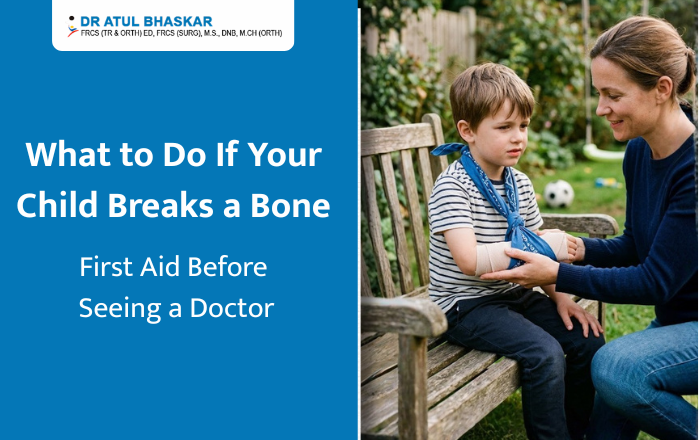
A snapped bone in your child is one of those moments that makes every parent’s stomach drop. One second they’re jumping off the monkey bars, and the next they’re crying in pain and refusing to move their arm. It’s scary, but here’s the good news: knowing what to do in the first few minutes can make a real difference in your child’s comfort and recovery.
This guide walks you through exactly what to do — and what not to do — if you suspect your child has broken a bone.
Not every fall results in a fracture, and it’s not always obvious right away. Here are some signs that point to a possible broken bone rather than a simple bruise or sprain:
If you notice any of these signs, it’s safer to assume it’s a fracture until a doctor confirms otherwise.
Children pick up on panic instantly. Take a breath before you react. Speak in a steady, reassuring voice. Your calmness will help your child stay still, which matters because unnecessary movement can worsen the injury.
This is one of the most important rules of fracture first aid. Avoid trying to straighten a bent limb or forcing your child to move the injured part. Let it stay exactly as it is until it’s properly supported.
Immobilization prevents further damage and reduces pain. Here’s how to do it safely at home:
If it’s an arm injury, a simple sling made from a piece of cloth can help keep it stable while you head to the hospital.
Wrap ice or a cold pack in a thin cloth and place it gently near (not directly on) the injured area for about 15-20 minutes. This helps reduce swelling and numbs the pain slightly. Never apply ice directly to the skin, as it can cause frostbite, especially in young children.
If the break is in an arm or leg, try to keep it elevated slightly above heart level, without moving the injured limb itself. This helps control swelling. If your child is in too much pain to allow this, don’t force it.
You can give an age-appropriate dose of paracetamol (acetaminophen) if your child is in pain, following the dosage instructions for their age and weight. Avoid giving ibuprofen or aspirin unless a doctor has already advised it, especially if there’s any bleeding or if surgery might be needed soon.
While heading to the doctor, keep an eye out for:
If any of these occur, treat it as a medical emergency and get to an emergency room immediately rather than waiting for a regular appointment.
Some fractures need urgent attention. Go to the emergency room right away if:
For less severe injuries, a visit to a pediatric orthopedic specialist within a few hours is usually appropriate.
Beyond the physical first aid, don’t underestimate the emotional side of this experience. A calm tone, a comforting hand, and simple explanations (“The doctor is going to help make it feel better”) go a long way in helping your child stay cooperative and less frightened.
Q1: Can I tell if a bone is broken just by looking at it?
Not always. Some fractures, especially in young children, don’t show obvious deformity. Persistent pain, swelling, or refusal to use the limb is enough reason to get it checked.
Q2: Should I try to splint the injury myself before going to the hospital?
Yes, a simple, gentle splint can help stabilize the area during transport, as long as you don’t force the limb into a new position.
Q3: How soon should my child see a doctor after a suspected fracture?
As soon as possible — ideally within a few hours. Delayed treatment can affect healing, especially in growing bones.
Q4: Is it okay to give my child pain medicine before seeing a doctor?
A dose of paracetamol appropriate for their age and weight is generally safe. Avoid other medications unless advised by a healthcare professional.
Q5: Do children’s bones heal faster than adults’?
Generally, yes. Children’s bones are still growing and tend to heal more quickly, but proper diagnosis and treatment are still essential to avoid complications.
Have questions? We’re just a message away! Contact us on WhatsApp — Click Here to Chat with Us
First aid can help manage the situation, but it’s never a substitute for professional evaluation. X-rays and expert assessment are the only way to confirm the extent of an injury and ensure it heals correctly.
For families in Mumbai looking for expert, compassionate care, Dr. Atul Bhaskar, a Pediatric Orthopedic specialist with over 35+ years of experience, is a trusted name for diagnosing and treating childhood fractures. If your child has suffered a bone injury, consulting a specialist like Dr. Bhaskar can help ensure the right treatment path and a smooth recovery.
Don’t wait to get expert care consult Dr. Atul Bhaskar for trusted pediatric orthopedic guidance today.
Dr. Atul Bhaskar, one of the prominent Paediatric Orthopaedic Surgeon in India has graduated from Seth G S Medical College, Mumbai. After doing his M.S (Orth) from K.E.M. Hospital, he pursued further training in the United Kingdom. He was on the “Yorkshire Orthopaedic Training Program” and obtained his orthopaedic fellowship, FRCS (Orth) and Surgical fellowship, FRCS (Glasgow) degrees. He has received the M.Ch Orth form Liverpool.
© Copyright 2026 Dr. Atul Bhaskar | All rights reserved.
Designed By DMX Digital