
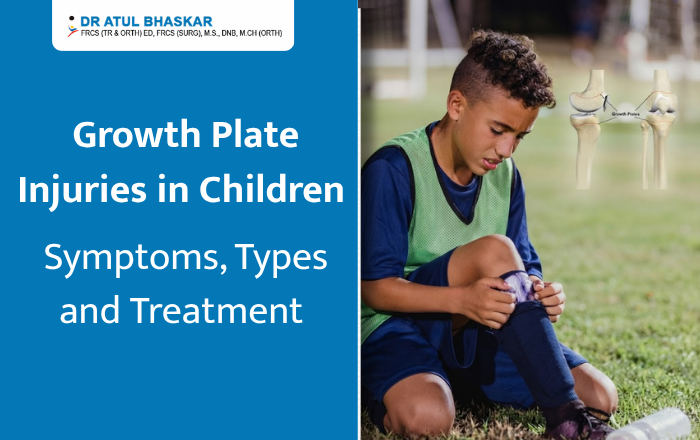
Your son comes home from a cricket match holding his wrist. There’s no obvious bend and he can still move his fingers, so everyone at home calls it a sprain. Three days later the wrist is still swollen and he winces every time he lifts his school bag. Pain like this near a joint in a growing child deserves a proper check, because it may be one of the growth plate injuries in children that orthopaedic doctors see very often.
The reassuring part is that most of these injuries heal well when they’re picked up early and treated correctly. Here’s what parents should know.
Growth plates are areas of soft, developing cartilage near the ends of a child’s long bones, such as the thigh bone, shin bone and forearm bones. Doctors call this area the physis. New bone forms here, which is how your child’s arms and legs get longer every year.
Once growth finishes, usually in the mid to late teens, the plates harden into solid bone. Until then they are the weakest part of the growing skeleton, often weaker than the ligaments around them. That’s why a fall that would sprain an adult’s ankle can injure the growth plate in a child instead.
A growth plate fracture is a common childhood injury, seen more often in boys and during the growth spurt around puberty. The wrist is the most common site, followed by the ankle, fingers and the bones around the knee. Typical causes include:
These injuries can look a lot like a sprain, which is why they sometimes get missed. Watch for:
A simple rule: if your child has pain near a joint after a fall and can’t use the limb normally, treat it as a possible fracture until a doctor says otherwise. Our guide on first aid when your child breaks a bone explains what to do on the way to the clinic, and our article on limping in children may help if a limp is the main sign.
Doctors grade these injuries using the Salter-Harris classification. Broadly, the higher the type, the greater the chance that future growth may be affected.
The end of the bone separates from the shaft. The X-ray may look almost normal. These usually heal well.
The most common type. Most heal well in a cast, sometimes after the doctor gently realigns the bone.
Because the joint surface is involved, it must line up accurately, so surgery is sometimes needed.
There’s a higher risk of growth problems, and surgery is often advised if the pieces have shifted.
Rare. The growth plate is compressed rather than cracked, so it may not show on the first X-ray and is sometimes noticed only when growth slows later.
The doctor will ask how the injury happened, examine the limb and check blood flow and sensation. X-rays are the main test, sometimes with an X-ray of the other side for comparison, since a normal growth plate can look like a crack. An MRI or CT scan may be advised if the X-ray is unclear or surgery is being planned.
Treatment depends on the fracture type, the bone involved, how much it has shifted and how much growth is left.
Most Type I and II injuries are treated with a cast or splint to keep the bone still while it heals. Read more in our comparison of cast vs splint for child fractures.
If the bone has moved, the doctor may ease it back into place without an operation, usually under sedation or anaesthesia, and then apply a cast.
Displaced Type III and IV injuries may need surgery, where the pieces are lined up and held with fine pins or screws.
After the cast comes off, gentle exercises or physiotherapy help restore movement and strength. Sports should restart only once the doctor confirms healing.
Children’s bones heal fast. Many growth plate fractures heal in about three to six weeks, depending on the type and location. Doctors usually still recommend review X-rays over the following months to make sure the growth plate keeps working normally.
Most children recover fully. In a small number, part of the growth plate closes early. This is called growth arrest, and it can cause one limb to be shorter or a bone to grow at an angle, as explained in our article on leg length discrepancy in children. Picked up early at review visits, it can usually be managed well, which is why those follow ups matter even when your child seems fine.
Not every fall can be avoided, and children should stay active. A few habits help:
Ongoing heel or knee pain in an active child can also point to overuse conditions such as Sever’s disease or Osgood-Schlatter disease.
1. What are the symptoms of a growth plate injury in a child?
Pain and swelling near the end of a bone close to a joint, difficulty using the arm or leg, limping and reduced joint movement. Serious injuries may show a visible deformity.
2. How long does a growth plate fracture take to heal?
Most heal in about three to six weeks with a cast or splint, followed by review visits for a few months to check that growth continues normally.
3. Can a growth plate injury stop my child from growing?
Usually not. In a small number of cases, mostly the more severe types, part of the plate may close early. Regular follow up helps catch this in time.
4. Is a growth plate injury the same as a sprain?
No. In children the growth plate is often weaker than the ligaments, so what looks like a sprain may actually be a fracture through the growth plate. It’s worth getting an X-ray.
Early assessment of growth plate injuries in children keeps treatment simpler and helps protect future growth. Dr. Atul Bhaskar is a Pediatric Orthopedic Surgeon with 35+ years of experience, specialising in paediatric joint reconstructive surgery. He treats children with fractures, growth plate injuries and other bone and joint problems in Mumbai and Thane. You can book an appointment for an evaluation.
Name: Dr. Atul Bhaskar, Pediatric Orthopedic Surgeon
Address: B Wing, Laxmi Business Park, Room No. 114, Sab T V – Kalinga Ln, off New Link Road, Laxmi Industrial Estate, Suresh Nagar, Andheri West, Mumbai, Maharashtra 400053
Phone: 98216 22992
Dr. Atul Bhaskar, one of the prominent Paediatric Orthopaedic Surgeon in India has graduated from Seth G S Medical College, Mumbai. After doing his M.S (Orth) from K.E.M. Hospital, he pursued further training in the United Kingdom. He was on the “Yorkshire Orthopaedic Training Program” and obtained his orthopaedic fellowship, FRCS (Orth) and Surgical fellowship, FRCS (Glasgow) degrees. He has received the M.Ch Orth form Liverpool.
© Copyright 2026 Dr. Atul Bhaskar | All rights reserved.
Designed By DMX Digital